
ART SALON ZÜRICH
FEMALE ARTISTS – FLORAL LANDSCAPES
22.–25.10.2026

VIP PREVIEW & OPENING RECEPTION
22.10.2026
Donnerstag / Thursday
VIP preview | 15–18 Uhr / 3–6 pm
Opening Reception | 18–21 Uhr / 6–9 pm
ÖFFENTLICHE MESSETAGE /PUBLIC DAYS
23.10.2026
Freitag / Friday
12:00 – 20:00 Uhr / 12:00 – 8:00 pm
24.10.2026
Samstag / Saturday
12:00 – 20:00 Uhr / 12:00 – 8:00 pm
25.10.2026
Sonntag / Sunday
12:00 – 18:00 Uhr / 12:00 – 6:00 pm
veranstaltungsort /VENUE
Halle 622 Zürich / Eventhalle
Therese-Giehse-Strasse 10, 8050 Zürich
ART SALON ZÜRICH
FEMALE ARTISTS – FLORAL LANDSCAPES
Die ausschliessliche Fokussierung auf Künstlerinnen und die Erzeugung eines Dialogs zwischen historischen und zeitgenössischen Positionen bilden die kuratorische Signatur der Galerie Glaab. Die Werkauswahl FLORAL LANDSCAPES, welche die Galerie Glaab am Art Salon Zürich 2026 zeigt, folgt diesem Ansatz und zeigt, wie Künstlerinnen über 300 Jahre hinweg Blumen, Pflanzen und Naturmotive interpretiert und in neue Bildwelten übersetzt haben.
Die Ausstellung spannt einen Bogen von der historischen botanischen Kunst bis zu fotografischen und digitalen Bildwelten. Maria Sibylla Merian (1647–1717) und Barbara Regina Dietzsch (1706–1783) verbinden präzise Naturbeobachtung mit künstlerischer Komposition. Imogen Cunningham (1883–1976) überführt florale Formen in die moderne Fotografie und reduziert in Leaves (1948) und Magnolia Bud (1920/2016) Pflanzenmotive auf Form, Struktur und Licht. Xiao Hui Wang (*1957) entwickelt in The Eros of Flowers (1999–2004) eine sinnliche fotografische Bildsprache: Durch extreme Nahaufnahmen werden Lotus, Tulpe, Orchidee, Mohn und Rose zu visuellen Landschaften, in denen Eros, Vergänglichkeit, Schönheit und Transformation miteinander verschmelzen.
Saeko Ehara (*1985) führt diese Auseinandersetzung in eine digitale Gegenwart. In The Tulip You Wore (2025) ver- bindet sie Fotografie mit holografischen Materialien und Silberfolie auf transparentem Papier sowie mit KI, kreativer Programmierung und generativer Kunst. Das japanische Konzept des „Kirakira“ – des Funkelns und Glitzerns – verwandelt die florale Form in eine poetische, digital erweiterte Bildwelt.
Eine bewusst eigenständige Position bildet Vera Molnár (1924–2023). Als Pionierin der Computerkunst löst sie sich von der unmittelbaren Darstellung der Natur und überführt deren Prinzipien von Ordnung, Struktur und Variation in abstrakte Systeme. Mit Triangles I–V (2023) erweitert sie den Begriff der „Landscape“ um eine abstrakte Dimension und setzt der beobachteten Natur eine durch mathematische Regeln und visuelle Variation geprägte Bildsprache entgegen.
The exclusive focus on women artists and the creation of a dialogue between historical and contemporary positions form the curatorial signature of Galerie Glaab. The selection of works for FLORAL LANDSCAPES, presented by Galerie Glaab at Art Salon Zürich 2026, follows this approach and explores how women artists across more than 300 years have interpreted flowers, plants, and motifs from nature, transforming them into new visual worlds.
The exhibition spans from historical botanical art to photographic and contemporary digital image worlds. Maria Sibylla Merian (1647–1717) and Barbara Regina Dietzsch (1706–1783) combine precise observation of nature with artistic composition. Imogen Cunningham (1883–1976) translates floral forms into modern photography, reducing botanical motifs to form, structure, and light in Leaves (1948) and Magnolia Bud (1920/2016). Xiao Hui Wang (*1957) develops a sensual photographic language in The Eros of Flowers (1999–2004): through extreme close-ups, lotus, tulip, orchid, pop- py, and rose become visual landscapes in which eros, transience, beauty, and transformation merge.
Saeko Ehara (*1985) carries this exploration into the digital present. In The Tulip You Wore (2025), she combines photo- graphy with holographic materials and silver foil on transparent paper, alongside AI, creative programming, and gene- rative art. The Japanese concept of “Kirakira”—meaning “sparkle” or “glitter”—transforms the floral form into a poetic, digitally expanded visual world.
A deliberately independent position is represented by Vera Molnár (1924–2023). As a pioneer of computer art, she moves away from the direct representation of nature and translates its principles of order, structure, and variation into abstract systems. With Triangles I–V (2023), she expands the concept of “landscape” into an abstract dimension, replacing direct observation of nature with a visual language shaped by mathematical rules and variation.
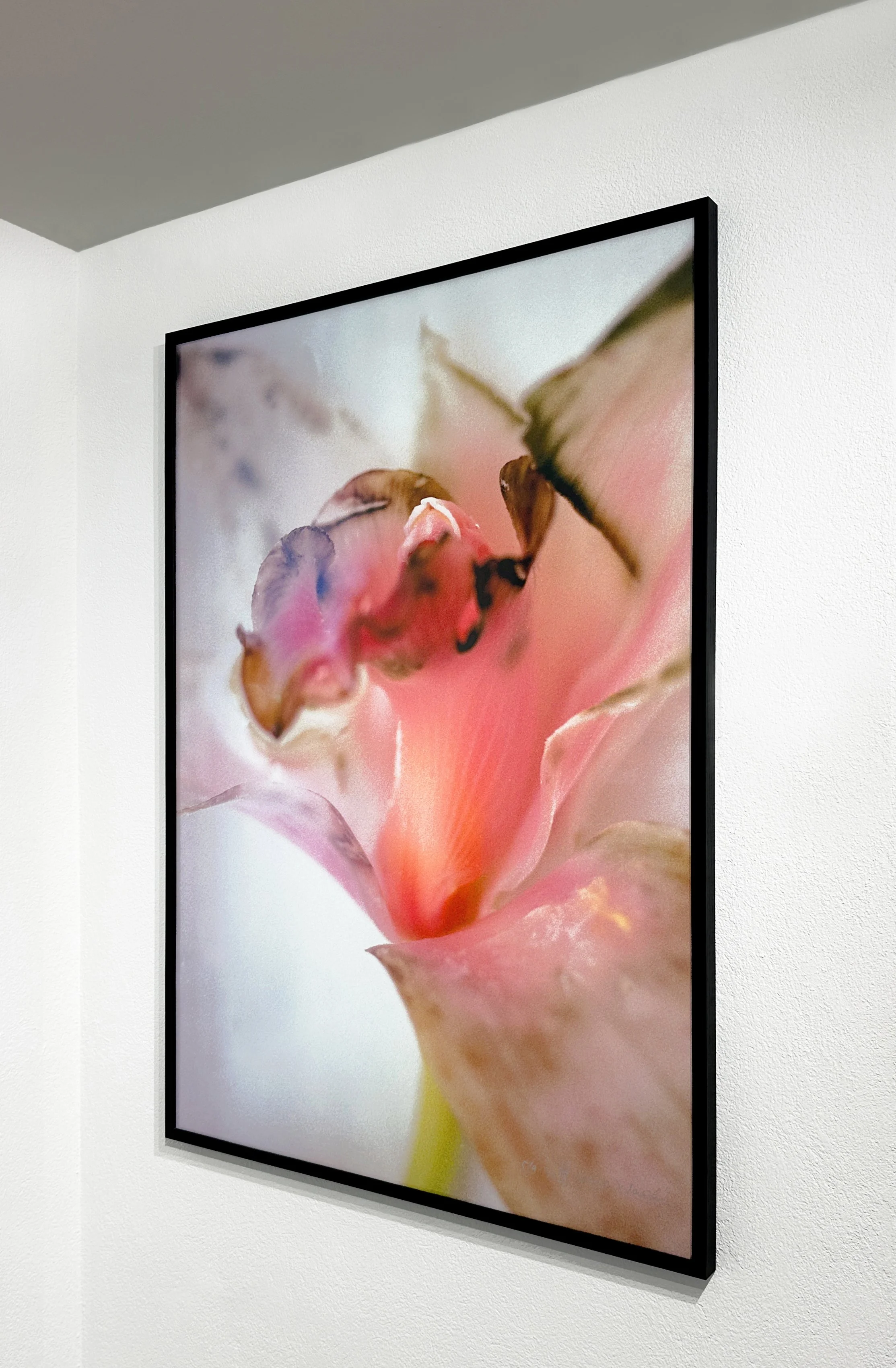
Xiao Hui Wang (*1957)
The Eros of Flowers · Nature (FE-6)
Teil der Serie: The Eros of Flowers
Fotodruck auf Papier, gerahmt in Holzrahmen mit entspiegeltem Glas
Masse Werk: 120 x 80 cm, Masse Rahmen: 122 x 82 x 2.9 cm
Edition mit 9 Werken
Erhältliche Editionsnummern: 5/9, 6/9
Unten rechts signiert und numeriert
Shanghai / CN
1999–2004
Xiao Hui Wang (*1957)
The Eros of Flowers · Nature (6)
Part of the series: The Eros of Flowers
Photo printing on paper, framed in a wooden frame with anti-reflective glass
Dimensions photography: 120 x 80 cm, Dimensions frame: 122 x 82 x 2.9 cm
Edition of 9 works, Available edition numbers: 5/9, 6/9
Signed and numbered lower right
Shanghai / CN
1999–2004